What I can help with.
I work solo, so you talk to me from the first call through to launch. No account managers, no brief passed between three people — and every service tells you upfront roughly what it costs and how long it takes.
API integration and orchestration.
I connect your website or app to your vendors' and internal systems' APIs. The data gets mapped into one shape and the calls are composed on the server, so the page waits as little as possible.
- from €50 / h
- 1–8 weeks
These are entry points, not a quote. You get the exact price after the first call — and from that moment it does not move unless the scope does. I am not registered for VAT — the prices shown are final.
enquire about this- Live prices, availability and dates right on the site
- Orders and enquiries landing straight in your systems
- A site that survives a vendor outage
- AI where it saves work: e.g. extracting orders from email into an API
Stock, pricing, bookings and shipping each have their own API, and each returns data differently. When the site calls them straight from the browser, the customer waits for the slowest one and the access keys sit in code anyone can read. Integrations are also where projects break most often: two sides agree to “just send it over the API”, nobody writes down what an empty field means, and three months later it is a production incident.
I work the other way round. The data map and the contract come first: an OpenAPI definition, request and response examples, an explicit list of error states. Implementation follows. Both sides look at the same thing, and testing can start before anything is finished.
One fast response instead of five slow ones
I compose the calls on the server, close to your customers. The browser sends one request, the server calls every system it needs at once, maps the data into the shape the site displays and returns only what the page needs. The customer sees price and availability before they would have had time to leave for a competitor. Internal data never leaves, and the access keys stay encrypted on the server.
Built for outages
The design assumes the other side will be unavailable sometimes. Caching and last-known values, idempotency, retries, queueing and alerting are all in scope — so your partner’s outage is not your website’s outage.
AI as a part, not the point
Where the rules cannot be written down in advance, such as invoices that all look different or orders arriving by email, I add AI to the integration: it extracts the data and sends it to the API like any other source. Where the rules can be written down, I write an ordinary program. It is cheaper and never makes anything up. A standalone AI tool starts at €1,400.
Documentation is written alongside the interface, not after it. Whoever takes the integration over from me does not have to reverse-engineer it out of the code.
- Systems connected
- Live data on the site
- Failure handling
- Documented interfaces
Web development.
A fast website built so it can connect to anything. You edit the content yourself and the source code is yours.
- from €1,000
- 2–6 weeks
These are entry points, not a quote. You get the exact price after the first call — and from that moment it does not move unless the scope does. I am not registered for VAT — the prices shown are final.
enquire about this- Company sites and presentations
- Internal tools and web apps
- Rebuilding an old site that no longer copes
- Launch, visitor numbers and a guide to editing it yourself
Prices, opening hours, a new item on the list — you change those yourself, without waiting for me. The text is not locked inside an admin panel you pay for every month: it sits in plain files where you rewrite a line, save, and the site updates itself. The guide for doing that comes with the handover, and it is written for a person, not a programmer. Bigger changes — a new section, a different structure — are my job, but for the everyday edits you do not depend on me.
I build the site so that somebody else can take it over in two years: clean code, no closed platform, and no plugins that stop working after a year with nobody left to fix them.
Why it is quick: the page is finished in advance and the servers keep it ready close to the visitor, so nothing has to be assembled each time someone opens it. It appears almost instantly even on a weak signal, and the infrastructure itself costs a couple of euros a month rather than hundreds. If you want someone to look after the site as well, there is hosting and operations for a monthly fee by volume. This site, the one you are reading, is built exactly that way.
What you get
Design and delivery, not just code. We start with what the site has to do and who it is for, and the structure follows from that. As standard it works on a phone, can be operated with a keyboard and a screen reader, is findable in search (structured data, sitemap, hreflang for multilingual sites) — and you can see how many people come.
On handover everything is yours: the source code, the documentation, every access credential and the way the site gets published. None of it is tied to me — carry on yourself, hand it to somebody else, or keep me on for maintenance.
- Custom-built
- Fast on mobile
- You edit the content
- No locked platform
IT analysis.
I go through the APIs and processes and write a data map and a brief with acceptance criteria. It is something to build from and to compare vendor quotes against.
- from €50 / h
- scope-dependent
These are entry points, not a quote. You get the exact price after the first call — and from that moment it does not move unless the scope does. I am not registered for VAT — the prices shown are final.
enquire about this- Requirements gathering and refinement
- Process and data models (UML, BPMN)
- Functional specs and acceptance criteria
- Impact analysis before a production change
I have spent six years as an analyst in banking. Most projects that stall do not stall on code — they stall because the person asking and the person building picture two different things behind the same sentence. My job is to find that gap before anyone pays for it.
How it runs
I start with the people who actually operate the process, not only the person who commissioned the project. Out of that comes a model of the current state, a list of the real pain points, and a proposal for the target state. Only then do I write the specification — with diagrams, a data dictionary, and acceptance criteria that can be tested.
I can also work inside an existing team as the project’s analyst. I know how change gets pushed through a corporate, and I will not hand you a proposal that dies in security review.
The analysis also stands on its own, with no development from me attached to it. The document you take out to vendors is the same thing that lets you compare what comes back — because everyone is finally pricing the same scope.
- Requirements
- Process models
- Functional specs
- Impact analysis
Hosting and operations.
I host your site and its connections and keep an eye on them, so servers are not your problem. You pay monthly for what the site actually does.
- from €29 / month
- by volume
These are entry points, not a quote. You get the exact price after the first call — and from that moment it does not move unless the scope does. I am not registered for VAT — the prices shown are final.
enquire about this- Hosting, server fees included
- HTTPS, domain and deployments
- Uptime and integration error monitoring
- Integration updates when a vendor changes their API
- Monthly traffic and error report
After launch I can host your site and integrations and look after them. The monthly price follows the number of requests the site handles, not how many features it has. A small site does not pay for capacity it never uses. Static files — pages, images, styles — do not count towards the volume.
There are three tiers: small up to 500 thousand requests a month, medium up to 5 million, and anything above that priced individually. Every tier includes hosting with server fees, HTTPS, deployments, uptime and API error monitoring and a monthly report. When a vendor changes their API, I update the integration before your customers notice.
Hosting is not a trap
Servers and accounts can be in your name. If you want to take operations over or move elsewhere, I hand it over with every credential and the documentation. The notice period is one month, and hosting with me is never a condition of any other project.
- Pay by volume
- Monitored errors
- One month's notice
Websites that are live.
Open either of them on your phone. Each one says who it was built for.
-
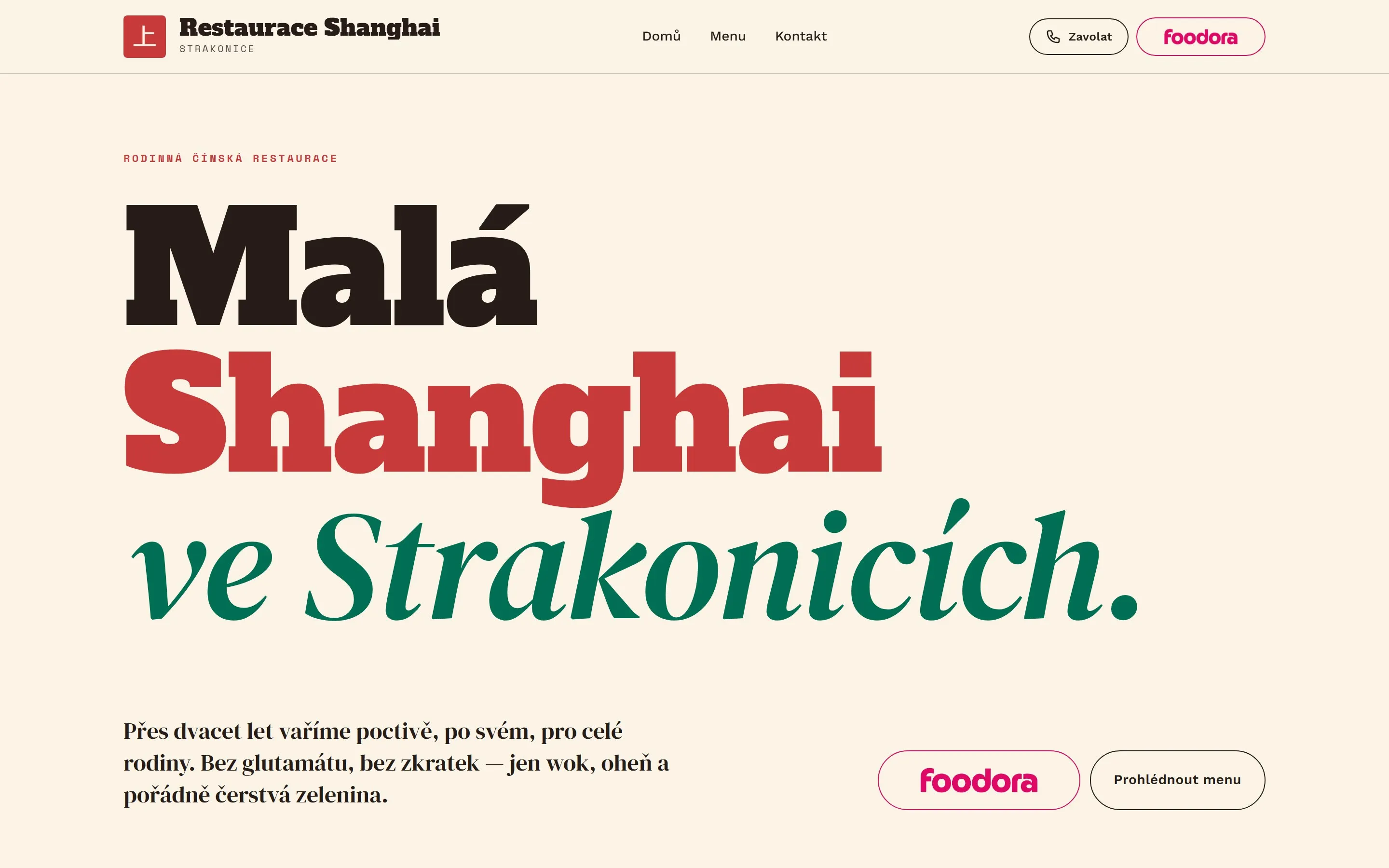
Restaurace Shanghai
commissionA guest can browse the whole menu on a phone — 123 dishes across fifteen categories, filtered by category. Next to it the map and the number for reservations, with ordering through Foodora, so the restaurant has no new system to run.
Hospitality restaurace-shanghai.cz ↗ -
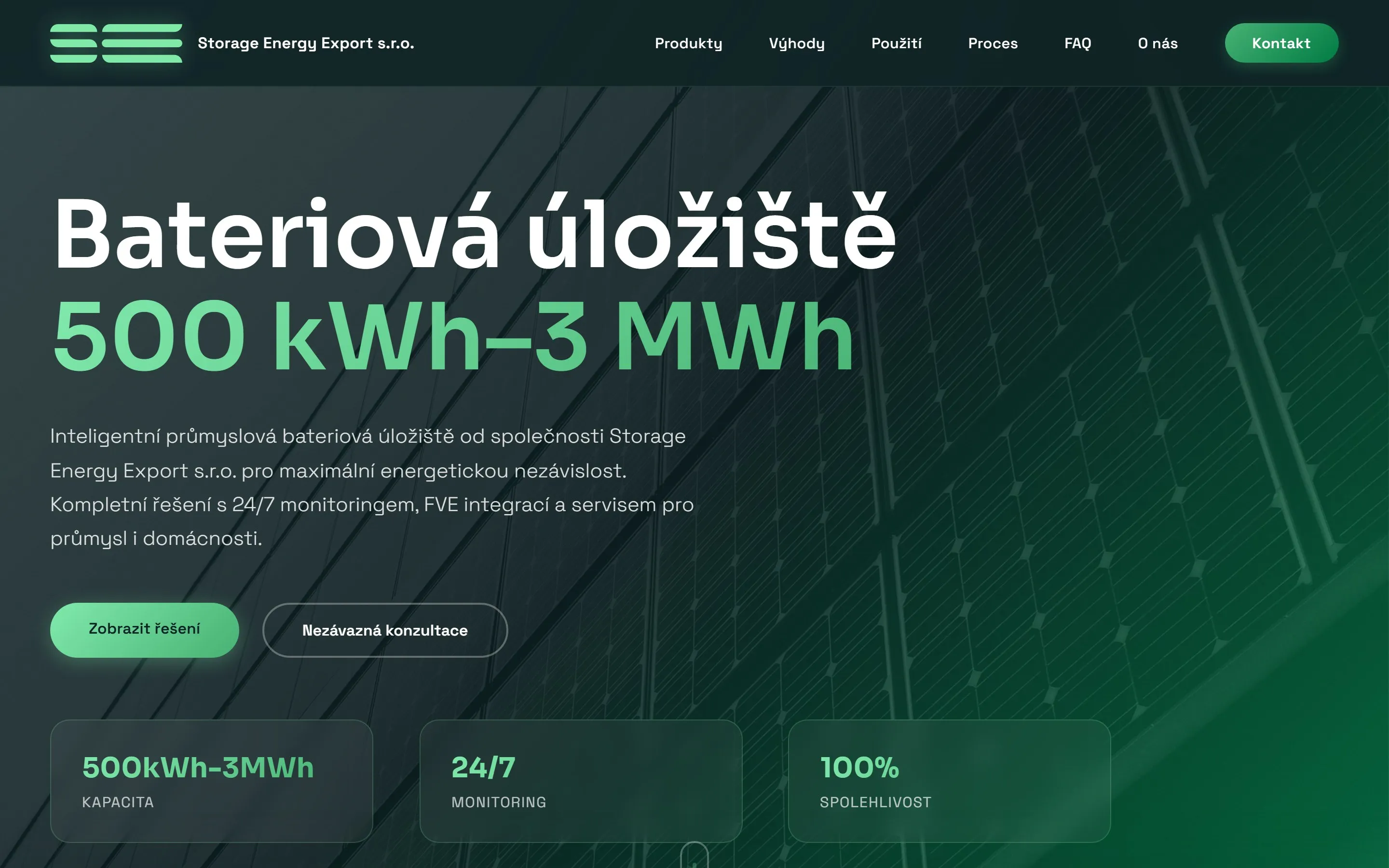
Storage Energy Export
family businessA manufacturer of industrial battery storage needed a site that answers the first round of questions for him. A visitor walks through three capacity tiers from 500 kWh to 3 MWh, the use cases and the delivery process, and reaches the enquiry form already knowing what to ask for.
Energy storageenergyexport.cz ↗
The data map first, then the code.
Integrations rarely stall on technology. They stall because two systems mean something different by the same field. That is why I start with analysis.
-
Call and scope
We go through the systems you use and what the site should show.
Output: scope, price, date
-
Analysis and mapping
I read the API documentation, map the fields and decide what happens during an outage.
Output: data map and criteria
-
Built in parts
Connections land one by one on a staging version you can see from week one.
Output: live staging version
-
Launch and operations
Launch, measurement and error monitoring. You can leave operations to me; it is optional.
Output: code, credentials, docs
True on every project
First call is free
Thirty minutes on your brief. You leave with an opinion even if we never work together.
The price holds
If the scope changes, you know the new price before the invoice arrives.
Everything is yours
Code, API documentation and credentials are with you as we go, not only at the end.
Before you write.
What nearly everyone asks. Missing your question? Put it in the enquiry.
Which APIs can you connect?
Anything with a documented REST interface, webhooks or a regular data export. If a vendor has no API, we find another route, such as an export that loads automatically.
What will it cost?
Integration and analysis from €50 per hour, because the scope is refined as the work goes. A website from €1,000 as one total, operations from €29 a month by volume. You get the exact number after the first call, and it holds unless the scope changes.
How long does it take?
A simple connection takes a week, orchestrating several systems up to eight, a website two to six. I confirm the date after the first call, and you see a usable version before the end.
What if a vendor's API goes down?
That is planned for from the start. The site shows the last known data, the call is retried, and you hear about the outage before your customers do.
Do I have to take hosting from you?
No. The site and integrations can run on your own accounts with a provider of your choice. Hosting with me is optional and can be ended with one month's notice.
You work alone. What if you get ill?
The code, the data map and the credentials are with you from week one, so anyone can take the project over at any time. On bigger projects I say upfront where I bring in a specialist.
How does invoicing work? And in English?
I am a sole trader, company ID 08946043, not VAT-registered, so the prices shown are final. Larger projects are invoiced in stages. I run projects in English and Czech, remotely or in person in Prague.
Which systems should your site connect to?
Tell me what you use and what the site should show. I reply within one working day.